Do you need a second freezer, or just to sort out the first?
Chapter 1 · Give the Freezer a Job
For people who'd rather fix the problem than buy the gadget
A plain-English guide to the money decisions every household runs into: food, heating, everyday buying, repairs and power outages. Each chapter walks through the numbers, then tells you straight: buy it, repair it, borrow it or skip it.

Walter's rules of thumb
Find the leak before you buy the machine.
A sale is information, not an instruction.
Age is a number, not a diagnosis.
01
Sound familiar?
A second freezer. The family-size pack. A space heater. A power station before the storm. Each one makes sense on its own. The book takes questions like these one at a time.
Do you need a second freezer, or just to sort out the first?
Chapter 1 · Give the Freezer a Job
Is the big pack still cheaper once you count what gets thrown out?
Chapter 2 · Bulk Is a Math Problem, Not a Virtue
Will a space heater lower your bill, or just add a second one?
Chapter 8 · Space Heat: Compare the Room, Not the Appliance Ad
Is that sale actually a good deal, or just a nudge to buy?
Chapter 12 · Sale Price Is Not the Same as a Buying Window
What really needs power when the lights go out?
Chapter 15 · Define Essential Before You Buy Backup Power
Does that repair quote explain what's broken, or just say it's old?
Chapter 21 · Repair Quotes: Ask Better Questions
02
Look inside
These are actual pages from the book. Tap any of them to read it full size.
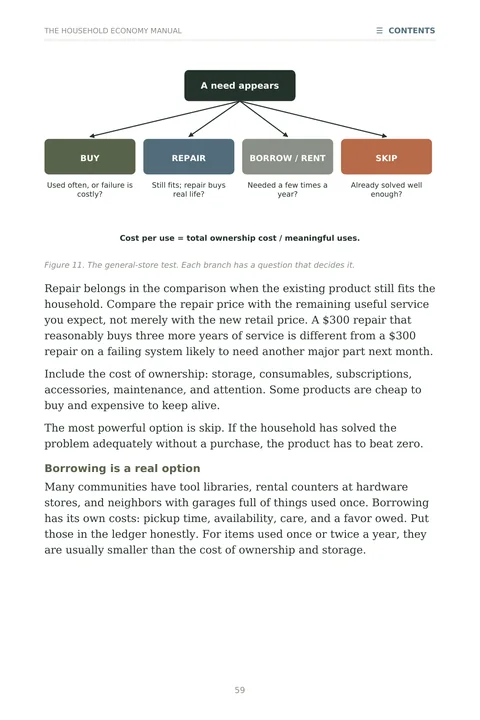
Page 59Buy, repair, borrow or skip, and the one question that decides each.
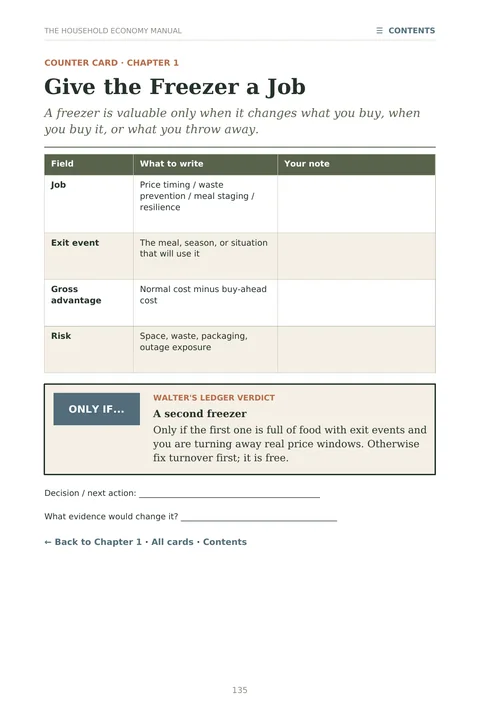
Page 135Every chapter boiled down to one page you can print.
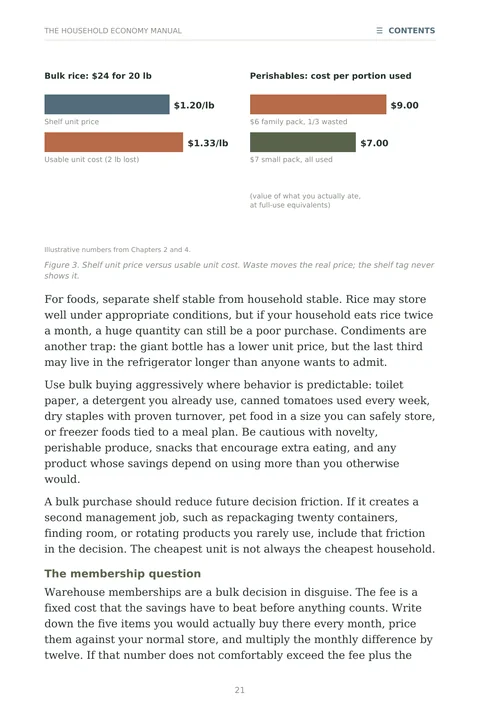
Page 21Why the big pack isn't always the cheaper one.
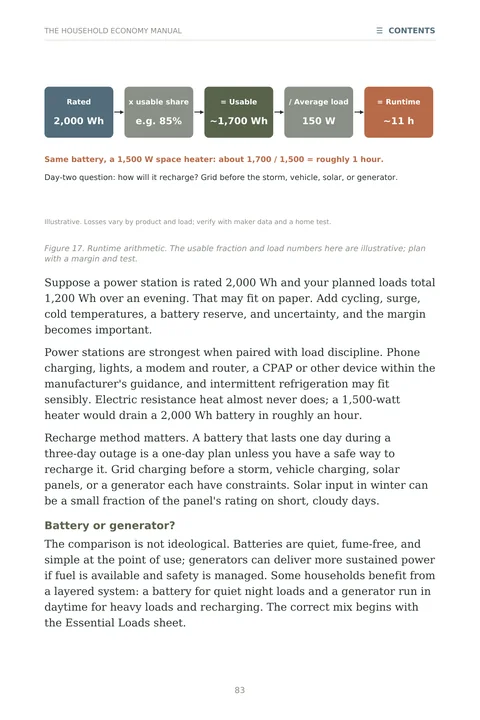
Page 83How long a backup battery really lasts.
03
How it works
The whole book uses the same simple approach. It works for a $5 purchase in the store and for a $1,500 repair quote.
Will you use it often, or is going without costly?
Does the old one still do the job if fixed?
Only need it a few times a year?
Is the problem already solved well enough?
Cost per use = what it costs to own ÷ how many times you'll really use it
Every answer comes with the reasons behind it, and what would change it for your house.
04
Try the math
The price tag only tells you half the story. What matters is what it costs each time you use it. Try it with your own numbers.
The example from the book: a $180 tool used 60 times works out to $3 a use. Use it six times and it's $30 a use. For something you'll only need a couple of times a year, renting or borrowing often makes more sense, and it doesn't take up space in the garage.
| Times used | Cost each time |
|---|---|
| 6 | $30 |
| 60 | $3 |
Example numbers from the book. Your prices will be different.
28 chapters like this, each with the numbers and a straight answer.
05
What's inside
You don't have to read it front to back. Start with whatever decision is in front of you. Each chapter has a short example, the numbers, how to check it worked, three things to do now, and a clear answer at the end.
Part I · 5 chapters
Get more out of the freezer and pantry, and throw less food away.
Part II · 5 chapters
Fix the drafts before you buy more heat.
Part III · 4 chapters
Before you buy, check whether repairing, borrowing, waiting or skipping is better.
Part IV · 5 chapters
Work out what really needs power in an outage, and plan for just that.
Part V · 4 chapters
Look after what you have, and know when a repair is worth it.
Part VI · 5 chapters
A short check-in each season, so winter and summer don't catch you out.
06
Is it for you?
Not by buying anything. The quick start is three things that cost little or nothing:
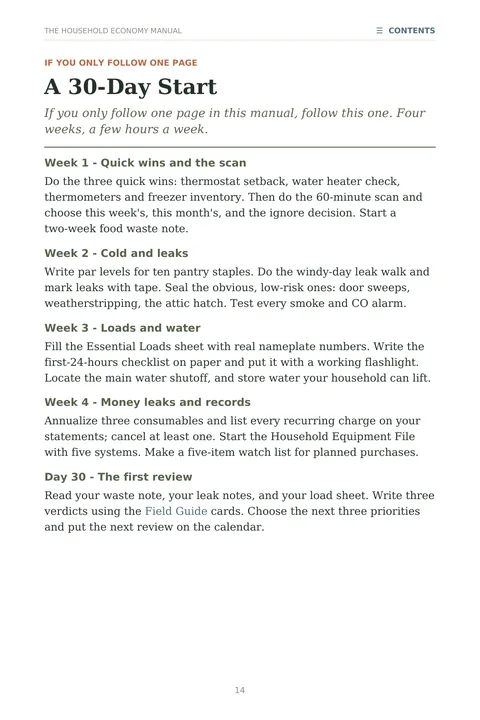
Then a one-hour walk around your home shows what to tackle this week, this month, and what to ignore. There's a 30-day plan if you want one.
07
About Walter

Walter is the voice of the book: calm, practical, and a little skeptical of gadgets and stockpiles. His first question is always the same. What do you actually need this for?
He's a made-up character, not a real expert. He doesn't claim to have run a store, worked a trade or tested anything himself. So the book doesn't ask you to take his word for it. It shows its work, and marks every claim as one of three things:
The safety advice comes from U.S. government sources like the Department of Energy, FoodSafety.gov, Ready.gov and the Consumer Product Safety Commission, all checked in October 2026.
08
Get the book
No upsells or "bonuses". The checklists and worksheets are in the book, right where you need them.
PDF + EPUB · 181 pages · First edition, 2026
Spend less. Waste less. Stock smarter. Keep the essentials running.
If it talks you out of one thing you didn't need, it's done its job.
Get the book · $39You'll pay on Gumroad. Download links for both files arrive by email right after.
If the book isn't useful to you, email [email protected] within 14 days and you'll get your money back.
Not included: a printed copy, a course or a membership. The worksheets are for printing, or writing on in a PDF app.
09
Questions
No, it's digital. You get two files: a 181-page PDF for printing and reading on a computer, and an EPUB that reads nicely on phones, tablets and e-readers. Nothing is shipped.
You pay through Gumroad. Right after, you'll get an email with download links for both files. They also stay in your Gumroad library if you need them again.
Email [email protected] within 14 days of buying and you'll get a full refund.
No. The quick start is all settings, checks and lists that cost little or nothing. A lot of the answers in the book are "repair first", "buy later" or "skip it".
As much as you want. The quick start is three small jobs and a one-hour walk around your home. After that, you just open the chapter for whatever decision comes up. The 30-day plan is optional, a few hours a week.
Yes. Most of it is about buying, food, schedules, records and outage planning, which work the same whether you rent or own. Anything that changes the building itself depends on your lease, so check with your landlord first.
The approach works anywhere. The sources and example prices are American, so swap in your own prices, energy rates, climate and local rules.
Print them, or write on them in a PDF app that lets you add notes. They're printable pages, not fill-in forms.
The safety and factual advice comes from U.S. government sources such as the Department of Energy, FoodSafety.gov, Ready.gov and the Consumer Product Safety Commission. They're all linked in the book and were checked in October 2026. The math is shown so you can redo it, and opinions are labeled as opinions. Rules can change, so check the source before acting on anything safety-related.
No. Walter Rowan is a fictional character. He doesn't claim any credentials or personal experience, and the households in the book are made-up examples, not reviews.
Run the numbers. Keep what works. Skip what doesn't.
PDF + EPUB, instant download · 14-day refund · Pay once